

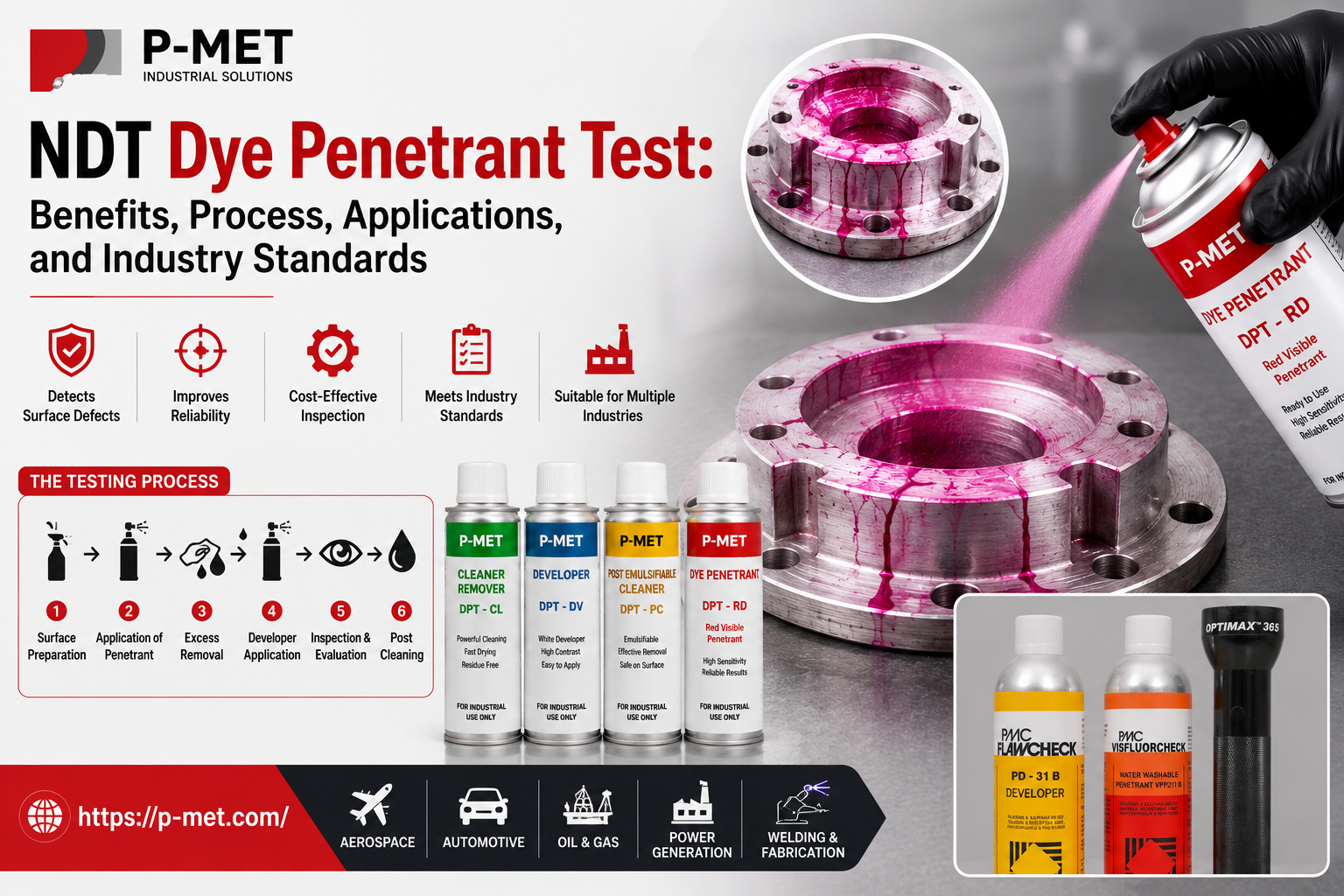
NDT Dye Penetrant Test: Benefits, Process, Applications, and Industry Standards
Quality assurance is a critical requirement across modern manufacturing and engineering industries. Components used in aerospace, automotive, energy, construction, and heavy fabrication must be inspected carefully to identify surface defects before they become serious operational issues. Among the most widely used non-destructive examination methods is the NDT Dye Penetrant Test, a technique designed to reveal surface-breaking discontinuities without causing damage to the material being inspected. The process relies on a specially formulated dye penetrant chemical that enters small openings through capillary action, helping inspectors identify imperfections that may otherwise remain hidden. Its simplicity, accuracy, and cost-effectiveness have made it an important inspection solution across a wide range of industrial sectors.
Understanding the Process, Benefits, Applications, and Standards
The ndt dye penetrant test is a surface inspection method used to detect cracks, seams, laps, porosity, and other discontinuities in metallic and non-metallic materials. Unlike destructive evaluation techniques, this approach allows manufacturers to verify product integrity without affecting usability. Because it can identify extremely fine flaws, it remains an essential part of quality control programs worldwide.
The procedure follows a systematic sequence to ensure accurate and reliable results. First, the inspection surface is thoroughly cleaned to remove contaminants such as grease, oil, dust, rust, and paint. Proper cleaning is essential because surface contamination can interfere with flaw detection. After preparation, an inspection liquid is applied evenly across the area and allowed to remain for a specified dwell period. During this stage, the liquid enters any surface-opening imperfections.
Once the dwell time is complete, excess material is removed carefully from the surface while retaining the liquid trapped inside discontinuities. A developer is then applied to draw the retained liquid back to the surface, creating visible indications that can be evaluated by trained personnel. Finally, inspectors examine the component under appropriate lighting conditions and document the findings before performing post-inspection cleaning.
Key Benefits
- The popularity of this inspection method stems from several practical advantages:
- Detects extremely small surface flaws.
- Suitable for complex shapes and intricate geometries.
- Applicable to a variety of metallic and non-metallic materials.
- Provides quick inspection results.
- Requires relatively simple equipment.
- Supports preventive maintenance programs.
- Improves product reliability and operational safety.
- Offers a cost-efficient quality control solution.
These advantages make it particularly useful for organizations seeking dependable inspection methods without investing in highly specialized equipment.
The technique is commonly applied to a broad range of materials. Steel, stainless steel, aluminum alloys, copper alloys, ceramics, and certain plastics can all be evaluated effectively. However, highly porous materials may produce inaccurate indications because the inspection liquid can spread into areas unrelated to actual defects.
Industries around the world rely on this process for quality verification and maintenance purposes. In aerospace manufacturing, aircraft structures, turbine components, and engine parts undergo routine examination to ensure compliance with strict safety requirements. Automotive manufacturers use it to inspect engine components, suspension systems, transmission housings, and critical structural parts. The oil and gas sector employs the method to assess pipelines, pressure vessels, storage tanks, and valves where structural integrity is essential.
Similarly, power generation facilities use inspection procedures on turbines, boilers, heat exchangers, and rotating equipment to identify flaws before they result in costly downtime. Fabrication and welding industries also depend on surface flaw detection to verify weld quality and detect imperfections that may affect long-term performance.
The effectiveness of the process depends significantly on the quality of inspection materials used during evaluation. Reliable ndt chemical products play a major role in achieving accurate and repeatable inspection results. These materials generally include cleaners, removable inspection liquids, fluorescent formulations, developers, and post-cleaning solutions. Proper selection and application of these materials help ensure consistent performance across different inspection environments.
| Category | Details |
| Suitable Materials | Steel, Stainless Steel, Aluminum, Brass, Copper Alloys, Ceramics, Plastics |
| Common Applications | Aerospace components, Automotive parts, Pipelines, Storage tanks, Turbines, Boilers, Welded structures |
| Industry Standards | ASTM E1417, ASTM E165, ASME Section V, ISO 3452 Series, EN Standards |
| Key Benefits | Detects fine flaws, Cost-effective, Fast inspection, Suitable for complex geometries, Improves reliability |
| Inspection Materials | Cleaners, Visible inspection liquids, Fluorescent inspection liquids, Developers, Post-cleaning solutions |
To ensure consistency and reliability, inspection procedures are governed by internationally recognized standards. ASTM E1417 provides widely accepted guidelines for liquid examination practices, while ASTM E165 outlines general requirements for inspection activities. ASME Section V establishes examination requirements for pressure-containing equipment and industrial systems. The ISO 3452 series offers internationally recognized guidance, helping organizations maintain consistency across global operations. European standards further support compliance requirements within regulated industries.
Several factors influence inspection accuracy. Surface preparation quality, dwell time, environmental conditions, lighting, material characteristics, and inspector competency all play significant roles in determining reliable results. Organizations that follow established procedures and maintain proper training programs typically achieve better inspection outcomes and improved quality assurance performance.
Conclusion
As manufacturing standards continue to evolve, surface flaw detection remains a vital component of quality assurance programs across multiple industries. Its ability to identify discontinuities without damaging components helps manufacturers improve safety, reduce failure risks, and maintain product reliability. When combined with qualified personnel, suitable inspection materials, and compliance with recognized international standards, this technique delivers dependable evaluation results. For industries focused on long-term performance and operational integrity, the dye penetration test continues to be one of the most effective methods for identifying surface imperfections before they develop into larger problems.