

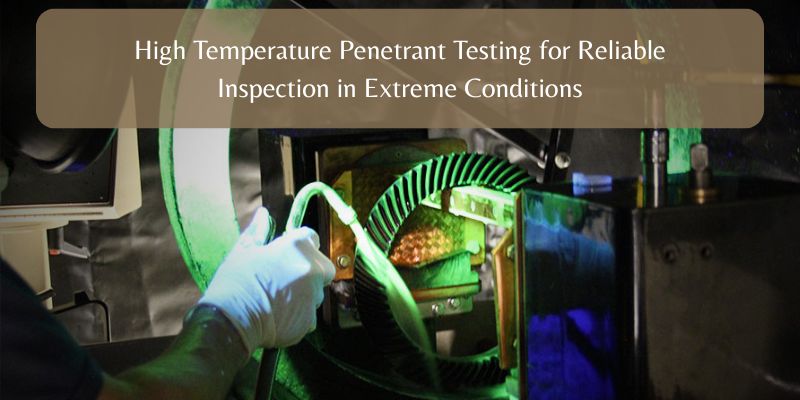
High Temperature Penetrant Testing for Reliable Inspection in Extreme Conditions
Introduction to High Temperature Inspection
Industrial components operating under extreme heat require specialized inspection methods to ensure their reliability and safety. Equipment used in power plants, aerospace systems, refineries, and heavy manufacturing is frequently exposed to elevated temperatures.
This inspection method is specifically designed for components that cannot be cooled down before testing. It allows inspectors to identify cracks, porosity, and surface discontinuities while the part is still hot. By eliminating the need for cooling, it reduces downtime and improves operational efficiency.
Why High Temperature Inspection Matters
Standard penetrant testing materials may evaporate or lose effectiveness when applied to hot surfaces. This can lead to unreliable results and missed defects. To overcome this limitation, high temperature penetrant testing uses specially formulated penetrants that remain stable at elevated temperatures.
This approach is particularly valuable in industries where shutting down equipment is costly or impractical. It enables inspection teams to perform maintenance checks without interrupting production processes.
Common applications include:
- Turbine and power plant components
- Furnace and boiler parts
- Petrochemical equipment
- Hot weld inspections
- Aerospace engine components
Because the inspection is performed at operating temperatures, it helps detect defects that may only appear under thermal stress.
Specialized Penetrant Solutions
To perform inspections at elevated temperatures, specially engineered chemical solutions are required. One commonly used option is high performance penetrant spray, which is formulated to maintain stability and visibility even on heated surfaces.
These penetrants provide several advantages:
- Strong visibility on hot surfaces
- Controlled evaporation rate
- Excellent penetration into fine cracks
- Reliable performance under heat exposure
- Easy removal after inspection
Multi Purpose Penetrant Spray
Inspection efficiency is further improved with products designed to perform multiple functions. A 3 in 1 high performance penetrant spray combines cleaner, penetrant, and developer properties in a single solution. This simplifies the inspection process and reduces the need for multiple products.
The benefits include:
- Reduced inspection time
- Simplified application process
- Lower material handling requirements
- Improved portability for field inspection
- Consistent inspection performance
Such multi purpose solutions are especially useful for on site inspections where quick evaluation is required.
Inspection Workflow at Elevated Temperatures
The high temperature dye penetrant testing method follows a structured workflow to ensure reliable detection of surface defects.
| Step | Description |
| Surface Preparation | Removal of loose contaminants from hot surface |
| Penetrant Application | Applying high temperature resistant penetrant |
| Dwell Time | Allowing penetrant to enter defects |
| Excess Removal | Cleaning surface while retaining penetrant inside cracks |
| Developer Application | Drawing penetrant out of defects |
| Inspection | Visual examination for defect indications |
Following this process ensures accurate identification of surface discontinuities even under extreme heat conditions.
Advantages
Inspection at elevated temperatures offers several operational and technical benefits. These advantages make it suitable for industries that operate continuously.
Key benefits include:
- No need to cool down equipment
- Reduced maintenance downtime
- Early detection of heat related defects
- Suitable for in service inspection
- Improved operational efficiency
Industrial Applications
This inspection technique is widely used in industries where equipment operates under thermal stress. Typical applications include:
- Power generation turbines
- Heat exchangers and boilers
- Refinery pipelines and vessels
- Hot weld inspection in fabrication plants
- Aerospace engine maintenance
Frequently Asked Questions
- What temperature range is suitable for high temperature penetrant inspection?
These inspections are typically performed on surfaces that are too hot for conventional penetrants. The exact temperature range depends on the formulation used.
- Can this inspection method be used during operation?
Yes, it is designed for in service inspection, allowing testing without shutting down equipment.
- Is surface cleaning required for hot inspection?
Basic cleaning is necessary to remove loose debris. However, the process is designed for quick preparation.
- What types of defects can be detected?
The method identifies surface cracks, porosity, seams, and heat related discontinuities.
- Where is this inspection method commonly used?
It is widely applied in power plants, aerospace systems, refineries, and heavy manufacturing industries.
Conclusion
Inspection of components operating at elevated temperatures is essential for maintaining safety and reliability in demanding industrial environments. Advanced penetrant solutions allow inspectors to identify defects without interrupting operations. With specialized products and dependable testing solutions, P-Met supports industries in performing accurate high temperature inspections while improving productivity and reducing downtime.