

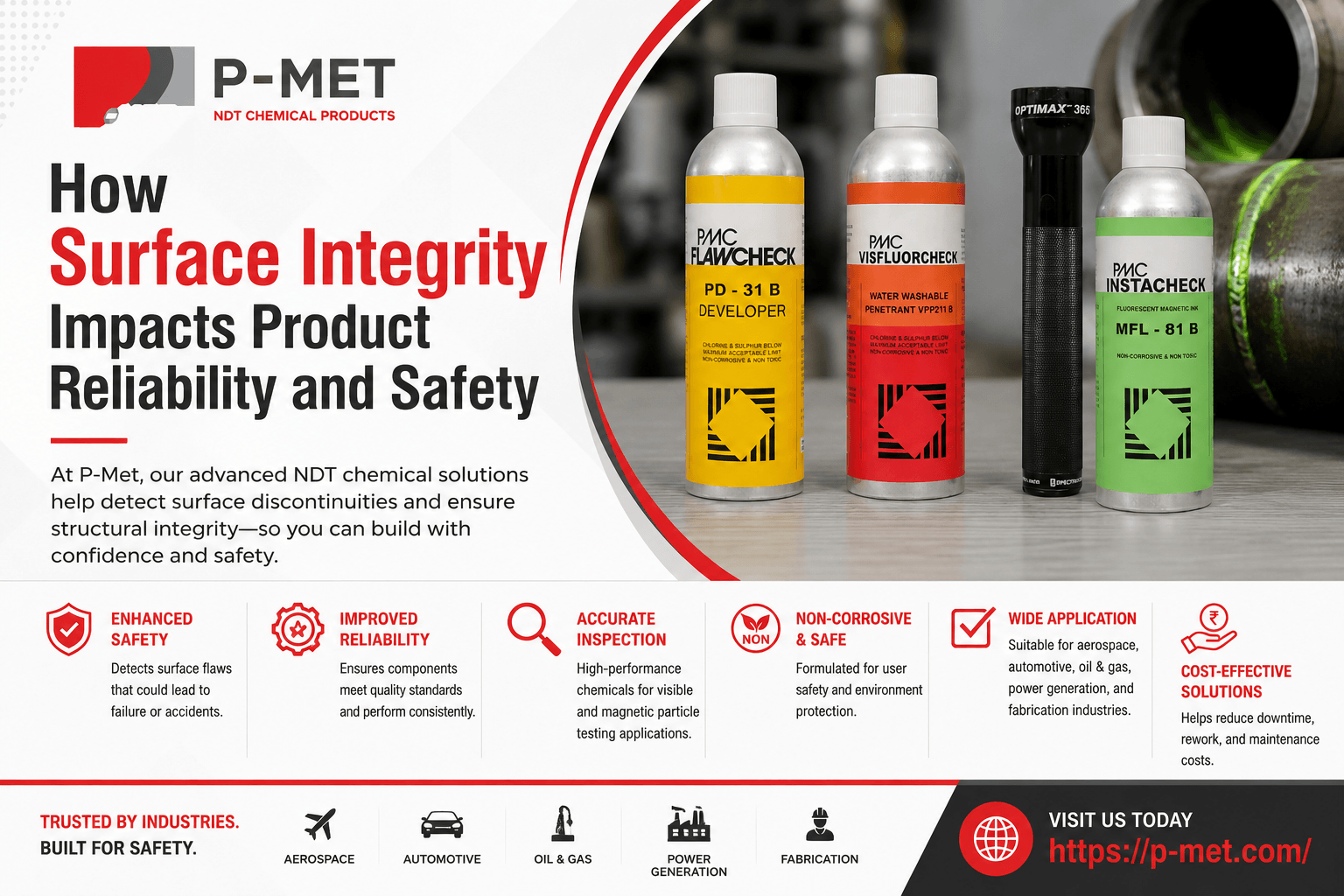
How Surface Integrity Impacts Product Reliability and Safety
Surface integrity is a critical factor in determining the performance, durability, and safety of manufactured products. Whether in aerospace, automotive, energy, or industrial applications, even minor surface defects can affect structural performance and lead to premature failure. Manufacturers place significant emphasis on maintaining high surface quality throughout production because it directly influences reliability and operational efficiency. The growing use of ndt chemical products has supported inspection processes that help identify surface irregularities before products enter service. As industries continue to demand higher quality standards, surface integrity remains a key component of successful manufacturing practices.
Understanding Surface Integrity in Manufacturing
Surface integrity refers to the condition and quality of a material’s surface after manufacturing processes such as machining, welding, casting, or finishing. It encompasses factors including surface roughness, residual stresses, microstructural changes, and the presence of defects.
Maintaining strong surface integrity helps achieve:
- Improved product performance
- Enhanced durability
- Greater operational reliability
- Better resistance to wear
- Increased safety during service
When surface quality is compromised, the risk of mechanical failure and performance degradation can increase significantly.
The Role of Inspection Methods in Surface Evaluation
Quality control systems rely on various inspection methods to evaluate surface conditions accurately. Among these methods, techniques involving dye penetrant chemical solutions are widely used to identify discontinuities that may not be visible to the naked eye.
Effective surface evaluation helps manufacturers:
- Detect cracks and flaws
- Verify production quality
- Improve manufacturing consistency
- Reduce product defects
- Support regulatory compliance
Early identification of imperfections allows corrective actions to be taken before products progress through the production cycle, reducing waste and improving reliability.
How Surface Defects Affect Reliability
Even small surface defects can have a significant impact on product performance. Cracks, porosity, scratches, and other imperfections may act as stress concentration points that weaken structural integrity over time.
The following table illustrates common surface defects and their potential consequences:
| Surface Defect | Potential Impact |
| Surface Cracks | Reduced structural strength |
| Porosity | Lower material integrity |
| Scratches | Increased wear potential |
| Corrosion Damage | Accelerated deterioration |
| Surface Inclusions | Reduced reliability |
Understanding these risks helps manufacturers prioritize quality assurance measures that protect product performance throughout its service life.
Ensuring Safety Through Effective Surface Inspection
Safety remains one of the primary reasons for maintaining excellent surface integrity. Industries that operate under demanding conditions often rely on advanced inspection methods to ensure products meet strict safety requirements.
Processes such as the ndt dye penetrant test play an important role in identifying surface-breaking discontinuities before they develop into larger problems. These inspection methods support safety objectives by:
- Identifying hidden flaws
- Verifying manufacturing quality
- Preventing unexpected failures
- Supporting maintenance planning
- Improving operational confidence
By detecting potential issues early, manufacturers can reduce risks and improve the overall safety of products used in critical applications.
Future Trends in Surface Integrity Management
As manufacturing technologies evolve, surface integrity management is becoming more sophisticated. Automation, digital inspection systems, and advanced analytical tools are helping organizations improve quality control processes and achieve greater precision.
Emerging trends include:
- Automated inspection technologies
- Real-time quality monitoring
- Artificial intelligence applications
- Predictive maintenance systems
- Advanced material analysis techniques
These innovations allow manufacturers to identify issues more quickly and maintain higher quality standards throughout production.
As expectations for reliability continue to increase, advanced surface integrity management will become even more important.
Conclusion
Surface integrity plays a fundamental role in determining product reliability, operational performance, and safety across a wide range of industries. Through effective inspection, quality control, and continuous process improvement, manufacturers can identify defects early and maintain high standards throughout production. Advances in inspection technologies continue to strengthen the ability to evaluate surface conditions with greater accuracy and efficiency. Organizations such as P Met contribute to these quality-focused efforts by supporting modern inspection practices and manufacturing excellence. As industry requirements continue to evolve, methods such as the dye penetration test will remain valuable tools for ensuring product integrity and long-term reliability.