

Magnaflux Water Washable Penetrant: Features, Applications, and Advantages
Detecting surface defects is essential for maintaining product quality, operational safety, and reliability in industries that depend on precision-engineered components. Cracks, porosity, laps, and other surface discontinuities can affect component performance if they remain undetected during inspection. Non-destructive testing (NDT) methods help identify these defects without damaging the material being examined.
The magnaflux water washable penetrant is used in liquid penetrant inspection to reveal surface-breaking imperfections in non-porous materials. Its water-washable formulation allows excess penetrant to be removed using water under controlled conditions, making it suitable for various manufacturing and quality-control applications.
Understanding its features, working principles, applications, and limitations helps quality professionals select an appropriate inspection method. This guide explains how water-washable penetrants work, where they are commonly used, and which practices support reliable inspection results.
What Is Magnaflux Water Washable Penetrant?
Magnaflux water-washable penetrant is a specialised inspection liquid used to detect surface-breaking defects in non-porous materials. It enters discontinuities through capillary action, and excess penetrant is removed with water. A suitable developer helps reveal indications, allowing inspectors to evaluate components according to the applicable inspection procedure and acceptance criteria.
What Is Magnaflux Water Washable Penetrant?
Magnaflux is a recognised brand associated with non-destructive testing products and inspection solutions. Water-washable penetrants are designed to identify discontinuities that open onto the surface of a test component.
Unlike inspection methods that require sectioning or destructive examination, penetrant inspection can assess suitable components without compromising their structural integrity.
The process is generally suitable for non-porous materials such as stainless steel, aluminium, and other metals, provided the selected penetrant is compatible with the material and application. It can also be used on certain non-metallic materials when permitted by the relevant procedure.
The specific properties of a Magnaflux product depend on its formulation and product designation. Therefore, inspectors should consult the manufacturer’s technical data sheet before selecting a penetrant for a particular application.
What Are the Main Features of Water-Washable Penetrants?
Water-washable formulations offer several practical features that support routine inspection operations.
1. Direct water-washing capability
The formulation allows excess penetrant to be removed with water, eliminating the need for a separate emulsifier in the normal water-washable process. Correct washing is essential because excessive washing can remove penetrant from defects and reduce indication visibility.
2. Surface-defect detection
The penetrant enters surface-opening discontinuities through capillary action. After excess material is removed and a suitable developer is applied when required, penetrant retained in the defects produces visible indications.
3. Flexible inspection applications
Depending on the product classification, penetrants may be available for visible-colour or fluorescent inspection. Visible systems typically produce contrasting indications under appropriate lighting, while fluorescent systems use ultraviolet-A (UV-A) illumination under specified conditions.
4. Compatibility with inspection procedures
Water-washable penetrants can be incorporated into established quality-control processes. Their suitability depends on the component material, surface condition, defect requirements, inspection environment, and governing specification.
5. Practical process integration
The water-washing stage can simplify excess-penetrant removal in production environments with appropriate washing facilities, water management, and inspection controls.
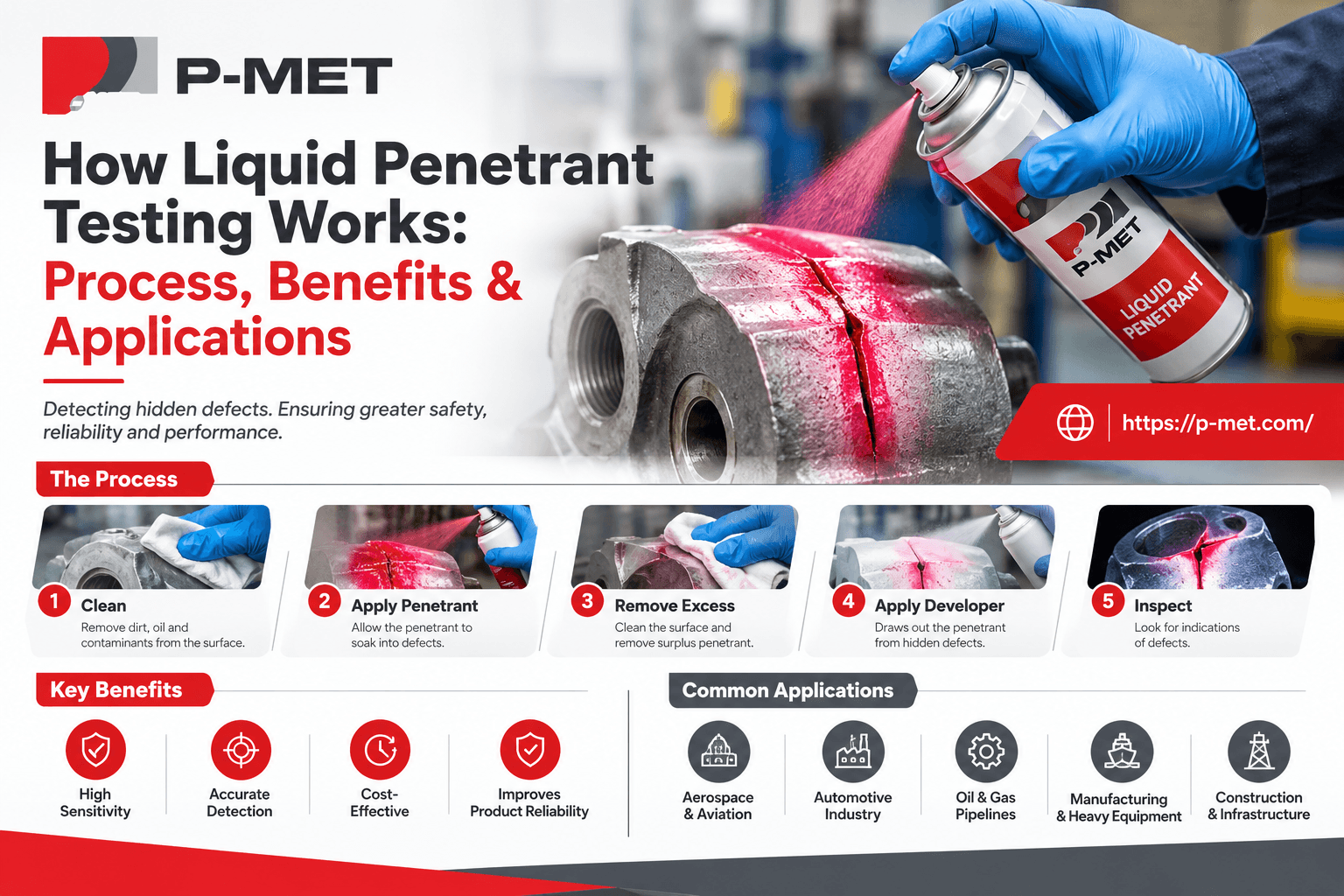
How Does the Inspection Process Work?
Understanding each inspection stage helps prevent errors and improve the reliability of results.
Step 1: Prepare the surface
Remove oil, grease, dirt, paint, and other contaminants using an approved cleaning method. The surface must be sufficiently clean and dry for penetrant to enter discontinuities. Contaminants can block defect openings and cause missed indications.
Step 2: Apply the penetrant
Apply the selected penetrant uniformly to the inspection area. Allow the specified dwell time so that the liquid can enter surface-breaking discontinuities. Dwell time varies by product, material, temperature, and applicable procedure.
Step 3: Remove excess penetrant
Wash the surface using the manufacturer’s recommended water pressure, temperature, and technique. Avoid excessive washing, which may remove penetrant trapped inside defects.
Step 4: Dry the component when required
Follow the specified drying procedure before applying the developer. Inadequate drying or excessive heat can affect the inspection process, depending on the product and procedure.
Step 5: Apply the developer
Use the developer type and application method specified for the inspection system. The developer helps draw retained penetrant towards the surface, making indications easier to observe.
Step 6: Examine and evaluate indications
Inspect under the required lighting conditions. Record relevant indications, assess them against the applicable acceptance criteria, and document the results. Clean the component after inspection when required.
How Is Zyglo Testing Related to Water-Washable Penetrants?
Zyglo testing is a fluorescent penetrant inspection method associated with Magnaflux’s Zyglo product range. It is used to reveal surface-breaking discontinuities that may be difficult to identify through unaided visual examination.
In this process, a compatible fluorescent penetrant enters surface defects. After controlled excess removal and the required processing stages, the inspector examines the component under suitable UV-A lighting. Discontinuities may appear as bright fluorescent indications against a darker background.
Zyglo systems can be useful for inspecting precision components, machined parts, and other suitable items where defect visibility is important. However, not every water-washable penetrant is a fluorescent Zyglo product. Product selection must match the required sensitivity, inspection specification, and processing conditions.
Where Are Water-Washable Penetrants Commonly Used?
Water-washable penetrants are used across several industries where surface integrity and manufacturing quality are important.
Aerospace and aviation
Suitable aircraft components may require penetrant inspection to identify surface-breaking discontinuities during manufacturing, maintenance, or overhaul. The approved procedure must account for component material, service requirements, and aviation quality controls.
Automotive manufacturing
Manufacturers may use penetrant inspection on suitable machined, forged, or other non-porous components to identify surface imperfections before assembly or release.
General engineering and fabrication
Precision-machined parts, metal components, and fabricated items may undergo penetrant inspection as part of incoming material checks, in-process inspection, or final quality verification.
Power generation and industrial equipment
Selected components used in turbines, pumps, and other industrial systems may be inspected when the material, geometry, surface condition, and governing code make penetrant testing appropriate.
Tooling and metalworking
Dies, tools, and precision components can be inspected for relevant surface-breaking defects, particularly when their condition influences product quality or operating performance.
What Are the Advantages and Limitations?
The main benefit of water-washable penetrants is convenient excess removal, but the method also has limitations that quality teams must consider.
| Factor | Advantages | Limitations |
| Cleaning process | Excess penetrant can be removed with water | Washing must be carefully controlled |
| Defect detection | Reveals surface-breaking discontinuities | Cannot reliably detect defects that do not reach the surface |
| Component condition | Usually non-destructive to suitable components | Contaminants or rough surfaces can affect results |
| Production use | Can fit routine inspection workflows | Requires trained personnel and controlled conditions |
| Equipment needs | May require relatively simple application equipment | Lighting, washing, drying, and developer controls may still be necessary |
| Environmental management | Water-washing supports practical process handling | Wastewater and chemical residues require appropriate management |
How Does Liquid Penetrant Testing Support Quality Control?
Liquid Penetrant Testing is a non-destructive examination method that identifies discontinuities open to the surface of a component. It is particularly useful when a visual inspection alone cannot provide sufficient confidence about surface integrity.
The method does not measure the full depth of a crack or establish the internal condition of a component. Radiographic testing, ultrasonic testing, magnetic particle testing, or other methods may be necessary when the inspection requirement includes internal defects or different material conditions.
For consistent results, organisations should establish documented procedures covering surface preparation, penetrant application, dwell time, excess removal, developer application, examination conditions, and acceptance criteria.
Relevant guidance may include ISO 3452-1 for general penetrant testing principles and applicable ASTM E1417/E1417M requirements for liquid penetrant testing in industries where those standards are specified. The correct edition, contractual requirements, and any sector-specific code must be verified before inspection.
What Are the Best Practices for Reliable Inspection?
Reliable inspection depends on more than selecting an appropriate penetrant. Process control, personnel competence, and documentation are equally important.
- Verify product compatibility: Check the technical data sheet, material compatibility, sensitivity requirements, and specified operating conditions.
- Control washing conditions: Follow the approved water pressure, temperature, and washing duration to avoid removing penetrant from discontinuities.
- Maintain suitable examination conditions: Use the required lighting, equipment checks, and environmental controls for the selected inspection system.
- Train inspection personnel: Ensure inspectors understand the applicable procedure, indication interpretation, and acceptance requirements.
- Maintain traceable records: Document the product identification, batch details where required, component identification, processing parameters, results, and disposition.
Common mistakes include insufficient cleaning, incorrect dwell time, excessive washing, inappropriate developer application, and interpreting every visible indication as a rejectable defect. Indications must be evaluated against the applicable acceptance criteria rather than judged by appearance alone.
Organisations should also review wastewater handling, chemical storage, safety data sheets, and personal protective equipment requirements. These controls help support safe, consistent, and environmentally responsible inspection operations.
Key Takeaways
- Water-washable penetrants reveal surface-breaking defects in suitable non-porous materials.
- Controlled water washing is essential to prevent loss of defect indications.
- Product formulations differ, so the correct technical data sheet must be consulted.
- Zyglo systems support fluorescent penetrant inspection when appropriate.
- Penetrant inspection does not replace methods needed to identify internal defects.
- Recognised standards and documented procedures help ensure repeatable results.
- Trained inspectors and accurate records support dependable quality-control decisions.
Conclusion
Selecting the right penetrant inspection system requires an understanding of the component, material, expected discontinuities, and applicable acceptance criteria. The magnaflux water washable penetrant offers a practical approach to identifying surface-breaking imperfections when used with the correct preparation, washing, development, and examination procedures.
For specialised applications,
zyglo penetrant testing may provide the fluorescent indication visibility required by the inspection specification. Reviewing product documentation, following recognised standards, and maintaining trained inspection personnel helps organisations make informed quality-control decisions. For additional information on penetrant inspection chemicals and NDT practices, consult the relevant manufacturer’s technical documentation and qualified inspection professionals.