

Understanding Dye Penetrant Chemical Composition and the Power of Dye Penetration Testing
In industries where structural integrity can mean the difference between safety and catastrophe, non-destructive testing (NDT) is not optional — it is essential. At P-Met, a trusted manufacturer and supplier of NDT chemicals based in Vadodara, Gujarat, we specialise in delivering precision-engineered solutions that help industries detect flaws before they become failures. Central to our product range is the dye penetrant system — a deceptively simple yet highly effective inspection method used across manufacturing, aerospace, petrochemicals, and heavy engineering.
What Is Dye Penetrant Testing?
A dye penetration test is a widely used non-destructive testing method designed to identify surface-breaking defects in materials such as metals, ceramics, and plastics. Unlike destructive methods, this technique leaves the component fully intact and functional after inspection.
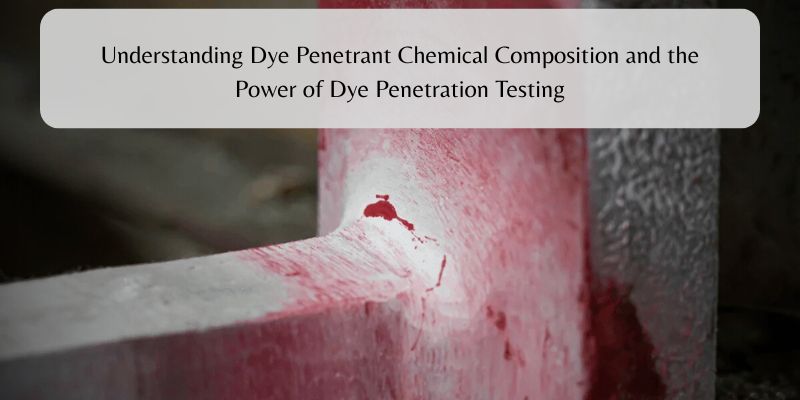
The process works by applying a liquid penetrant to the surface of a component, allowing it to seep into any surface cracks or discontinuities through capillary action. After a dwell time, excess penetrant is removed, and a developer is applied to draw the trapped liquid back to the surface — revealing defects as vivid, visible indications.
P-Met’s PMC Visible Dye Penetrant and PMC Fluorescent Penetrant products are engineered to deliver exceptional sensitivity and reliability, making them ideal for critical inspection environments.
Breaking Down the Dye Penetrant Chemical Composition
The effectiveness of any dye penetration test depends entirely on the quality and formulation of its chemical constituents. Understanding dye penetrant chemical composition helps engineers and inspectors select the right product for their application.
A typical dye penetrant chemical is formulated from four key components:
- Base Carrier Fluid This is usually a low-viscosity oil or synthetic solvent that gives the penetrant its ability to flow freely across surfaces and into fine cracks. The carrier must have excellent wetting properties and low surface tension.
- Dye (Visible or Fluorescent) For visible penetrants, a high-contrast red or red-violet dye is used, offering strong contrast against a white developer background. For fluorescent penetrants — such as P-Met’s PMC Fluorescent Penetrant — a fluorescent compound is used that glows vividly under ultraviolet (UV) light, enabling detection of even the most minute discontinuities.
- Surfactants and Emulsifiers These agents reduce the surface tension of the penetrant, enhancing its ability to wet and penetrate tight surface defects. They also facilitate the removal of excess penetrant during the cleaning stage.
- Stabilisers and Additives These ensure the dye penetrant chemical remains stable across a range of temperatures and storage conditions, preserving shelf life and maintaining consistent performance across multiple inspections.
P-Met’s formulations are engineered to meet stringent industry standards, ensuring compatibility with a wide range of substrate materials without causing corrosion or surface damage.
Industries That Rely on Dye Penetration Testing
The dye penetration test is a cornerstone inspection method across numerous critical sectors. P-Met proudly supplies NDT chemicals to Fortune 500 companies and global leaders including Reliance Petroleum, Larsen & Toubro, TATA, and Indian Railways, as well as international clients such as COOPERHEAT, ALSTOM, and DODSAL.
Our products are trusted in:
- Oil & Gas — For weld inspection on pipelines, valves, and pressure vessels
- Aerospace & Defence — For detection of fatigue cracks in turbine blades and structural components
- Power Generation — For routine inspection of boilers, heat exchangers, and turbines
- Automotive & Foundry — For quality control of cast and forged components
- Rail & Infrastructure — For ensuring the structural safety of rail components and civil structures
Why Choose P-Met for Your Dye Penetrant Chemical Needs?
At P-Met, quality is not just a promise — it is built into every formulation. Our PMC range of penetrant chemicals is developed by a highly experienced technical team capable of delivering customised solutions tailored to your industry’s specific requirements. We maintain compliance with stringent international standards, ensuring that every dye penetrant chemical we supply performs with maximum sensitivity, reliability, and safety.
Whether you require a standard visible penetrant for general manufacturing inspection or a high-sensitivity fluorescent system for aerospace-grade applications, P-Met has the expertise and product range to meet your needs.
Conclusion
The dye penetration test remains one of the most cost-effective and reliable methods for surface defect detection in non-destructive testing. Its performance, however, is only as good as the dye penetrant chemical composition behind it. By choosing P-Met’s scientifically formulated, field-proven penetrant systems, industries across India and beyond can be confident in their inspection results — protecting assets, ensuring compliance, and most importantly, safeguarding lives.
To learn more about P-Met’s full range of NDT chemicals and penetrant systems, visit www.p-met.com or contact our team for customised recommendations.